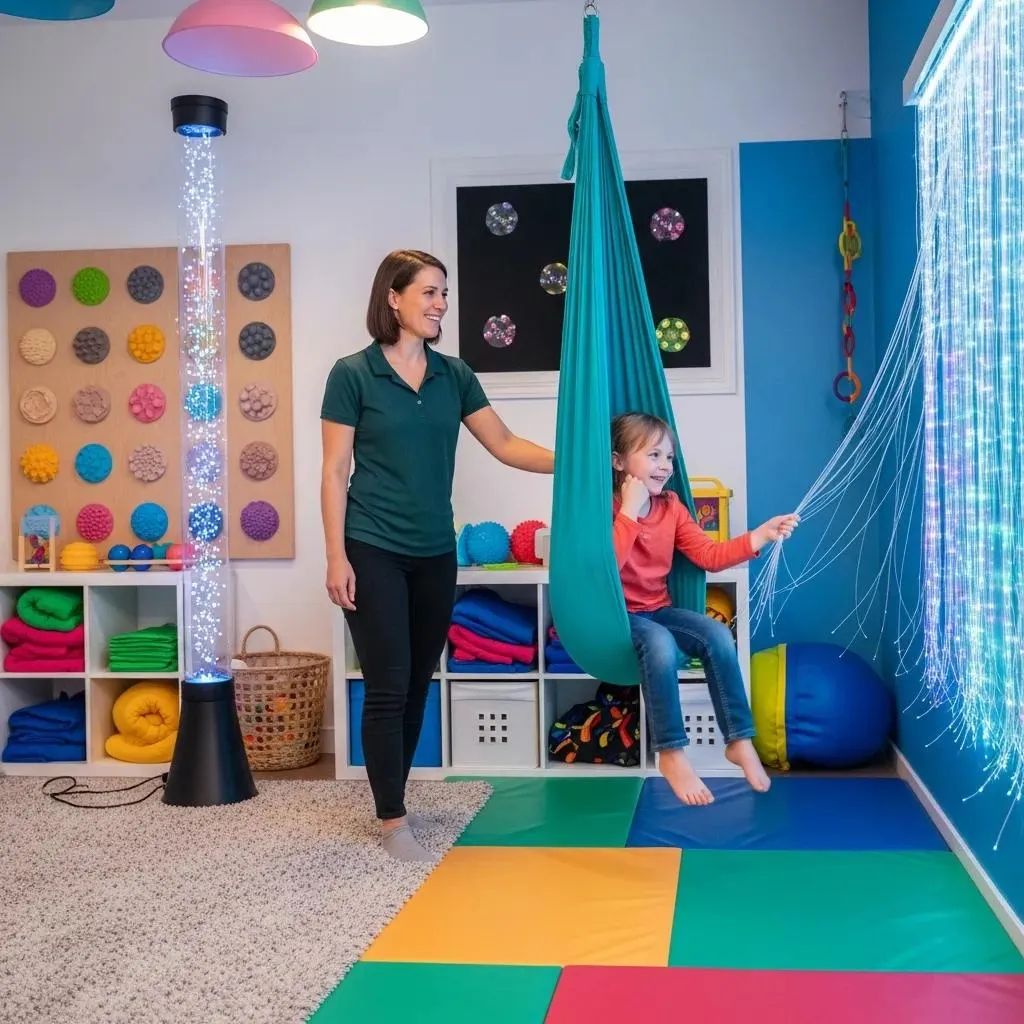

Children experience the world through their senses, but sometimes their brains struggle to make sense of all that input. This can lead to big feelings, trouble focusing, or challenges with daily tasks. OT suggestions for sensory integration can help children feel calmer, focused, and in control.
Sensory activities like jumping on a trampoline or crawling through a tunnel can support motor skills and body awareness. Playing with textured toys or using calming music can improve focus and emotional balance. For example, squeezing putty during homework or swinging gently before school can make transitions easier.
Parents play a significant role in this progress. When families use OT suggestions for sensory integration at home, kids feel supported and safe. With patience, consistency, and a little creativity, these activities can boost a child’s confidence and overall development.
Key Takeaways
- Engage in swinging and jumping activities to enhance vestibular and proprioceptive processing, improving motor skills and balance.
- Incorporate manipulative tasks like puzzles and bead stringing to develop fine motor skills and hand-eye coordination.
- Create sensory-rich obstacle courses that combine movement and sensory input for comprehensive skill integration.
- Utilize multi-sensory play to stimulate cognitive development, promoting memory retention and problem-solving abilities.
- Foster social-emotional growth through group sensory play, teaching cooperation, turn-taking, and empathy among peers.
Understanding Sensory Integration in Child Development
Although sensory integration occurs naturally during childhood, its profound impact on development is often underestimated. Sensory integration is the brain’s ability to organize and respond to sensory inputs from multiple sources, such as vision, hearing, and touch. This process is critical for forming neural pathways that support cognitive, motor, and social development.
Engaging children in sensory integration activities is significant for enhancing their ability to interact with their environment effectively. These activities help children develop fundamental skills for daily tasks, such as dressing and eating, while also facilitating psychological regulation and social interactions. When children face sensory processing challenges, their ability to participate in everyday activities can be impaired, highlighting the importance of understanding sensory integration in fostering comprehensive child development.
Play-based interventions can significantly improve motor coordination and body awareness, enabling children to navigate their environment better.
Key Sensory Integration Activities for Motor Skills
Engaging children in sensory integration activities is essential for enhancing their motor skills, as these activities provide meaningful opportunities for movement and interaction with their environment. Activities such as swinging, jumping on trampolines, and throwing balls promote vestibular and proprioceptive processing, facilitating motor control. Fine motor skills can be developed through manipulative tasks like puzzles, bead stringing, and cutting, which improve dexterity and coordination. Moreover, creating gross motor circuits that include climbing, crawling, and balancing challenges enriches sensory integration and motor planning.
These activities also help children adapt to various textural experiences, which further support adaptive motor behaviors by integrating sensory input with movement. Sensory-rich obstacle courses further support adaptive motor behaviors by integrating sensory input with movement. These activities not only improve motor capabilities but also lay the foundation for better tool usage, writing skills, and daily living tasks, as they help improve sensory processing that is crucial for effective motor coordination.
Enhancing Cognitive Development Through Sensory Play

Building upon the development of motor skills, sensory play serves as a crucial avenue for enhancing cognitive development in children. Engaging multiple senses during play stimulates cognitive processes, fostering skills in memory retention and problem-solving. As children interact with varied textures, they use abstract thinking and gather detailed information about their environment.
Sensory experiences promote critical thinking and hypothesis testing, mirroring the scientific method. Multi-sensory toys engage different brain areas, improving attention and learning efficiency.
Furthermore, sensory play enhances language development through descriptive interactions and imaginative storytelling. Early sensory-rich interactions establish a foundation for future academic success, promoting memory, recognition, and cognitive flexibility. By providing diverse sensory play opportunities, parents and caregivers can effectively support children’s neurodevelopment, laying the groundwork for vital cognitive skills.
Engaging in hands-on learning strategies can significantly reinforce these cognitive benefits by encouraging exploration and experimentation.
Activities to Promote Social-Emotional Growth
As children participate in sensory-based activities, they not only investigate their environment but also improve their social-emotional growth. Sensory integration activities enhance emotional regulation, allowing children to manage anxiety and develop coping mechanisms for overwhelming situations. Engaging in group sensory play fosters cooperation and shared attention, strengthening peer relationships.
These activities, especially those involving movement and touch, facilitate learning crucial social skills such as turn-taking and empathy. Furthermore, sensory-rich environments reduce sensory overload, promoting comfort and communication among peers. By integrating role-play and social stories, children gain insight into the emotions of others, bolstering their emotional awareness and intelligence.
Such practices are fundamental in nurturing adaptive behaviors and fostering meaningful social interactions, making it essential to address sensory integration in supporting autism development and participation. Additionally, targeted sensory activities provide unique opportunities for children to enhance their emotional control and self-regulation skills through engaging, purposeful play experiences.
Tailoring Sensory Integration Strategies for Individual Needs

Tailoring sensory integration strategies to personal needs is crucial for promoting effective development in children, particularly those with sensory processing challenges. Tailored interventions based on unique sensory profiles can significantly improve a child’s functional skills and self-regulation. By systematically applying targeted sensory inputs, caregivers can effectively address specific needs.
Furthermore, successful sensory integration impacts overall well-being, especially in individuals with sensory processing challenges. Understanding the importance of early detection is essential for optimizing these interventions.
| Strategy Type | Unique Needs Addressed |
|---|---|
| Tactile Activities | Reduces over-responsivity |
| Proprioceptive Input | Boosts body awareness |
| Visual Supports | Improves communication skills |
| Collaborative Training | Optimizes strategy implementation |
Frequently Asked Questions
How Can Parents Identify Sensory Processing Difficulties in Their Children?
Parents can identify sensory processing difficulties by observing children’s reactions to sensory stimuli, noting extreme reactions, motor skill challenges, or social withdrawal, and recognizing patterns of behavior linked to sensory overload or seeking behaviors.
How can I use OT suggestions for sensory integration in a child’s daily routine?
Start by adding sensory-rich activities like jumping, squishing play-dough, or using visual timers during transitions. These minor adjustments can provide calming or alerting input that helps your child feel more organized and ready to engage.
Are There Specific Sensory Activities for Children With Sensory Sensitivities?
Specific sensory activities for children with sensitivities include controlled swings for hypersensitive children, textured play for tactile defenses, and deep pressure techniques like weighted vests. Personalized approaches guarantee adequate support tailored to a child’s distinct sensory profile.
How Often Should Sensory Integration Activities Be Practiced?
Frequency of sensory integration activities can feel essential as air. They should be tailored to each child’s unique needs, with frequent short sessions—ideally at times of distress—to foster steady regulation and engagement throughout their day.
Can Sensory Integration Therapy Benefit Children Without Developmental Disorders?
Research suggests that sensory integration therapy may benefit children without developmental disorders by enhancing affective regulation, social skills, and adaptive behaviors. However, further large-scale studies are necessary to validate these potential outcomes in typically developing populations.
What Materials Are Recommended for Sensory Integration Activities at Home?
Recommended materials for sensory integration activities at home include tactile bins, DIY play dough, soft items for comfort, sound shakers, musical instruments, visual tracking games, a trampoline for balance, and weighted items for proprioceptive input.
Conclusion
Every child learns and grows in their way, and sensory integration activities can help them feel more comfortable and confident in the world around them. With the proper support, kids can build stronger focus, better motor skills, and more balanced emotions. These small changes often lead to significant improvements in daily life.
Simple things—like squeezing a stress ball, bouncing on a yoga ball, or listening to soft music—can help a child feel calm and ready to learn. When these activities are used often and with care, children begin to handle challenges more easily and feel proud of what they can do. They also build stronger connections with family, friends, and taught that you don’t have to figure it all out alone. If you have questions, need suggestions, or want help getting started, reach out to a pediatric occupational therapist. We’re here to guide and support your family every step of the way.
References
- https://pmc.ncbi.nlm.nih.gov/articles/PMC10955541/
- https://pmc.ncbi.nlm.nih.gov/articles/PMC3708964/
- https://www.triumphtherapeutics.com/the-role-of-sensory-integration-in-child-development/
- https://www.sensoryintegrationeducation.com/pages/what-is-si
- https://www.mastermindbehavior.com/post/the-impact-of-sensory-integration-techniques-in-aba
- https://www.physio-pedia.com/Sensory_Integration
- https://ivyrehab.com/health-resources/occupational-therapy/what-is-sensory-integration/
- https://www.otconnection.com/services/sensory-integration/
- https://www.healthline.com/health/autism/sensory-integration
- https://kuey.net/index.php/kuey/article/download/8783/6615/16871